Most people who do a tandem skydive do it once. They book it for a birthday, a charity fundraiser, or because someone dared them to, and they come back down with a slightly dazed expression and a story they will tell for years. A smaller group lands, looks up at the sky, and immediately starts asking about doing it again — but under their own parachute this time. The difference between those two groups is not courage. It is curiosity. The tandem jump is the experience. The skydiving course is the beginning of something else entirely.
Understanding both is worth doing before you book either.
The Scale of the Sport
Skydiving is larger than most people outside it realise. The British Parachute Association — British Skydiving — governs the sport across 80 affiliated drop zones in the UK. Over 250,000 skydives take place annually in the country. Globally, more than 6 million jumps happen each year across approximately 40 countries with organised sport parachuting infrastructure. The fatality rate in the UK sits at around 0.28 deaths per 100,000 jumps — statistically safer than horse riding, motorcycle riding, and a number of other activities that don’t generate the same level of pre-booking anxiety.
That safety record is not accidental. It reflects decades of equipment development, standardised training, and a regulatory framework that takes progression seriously.
What a Tandem Skydiving Adventure Involves
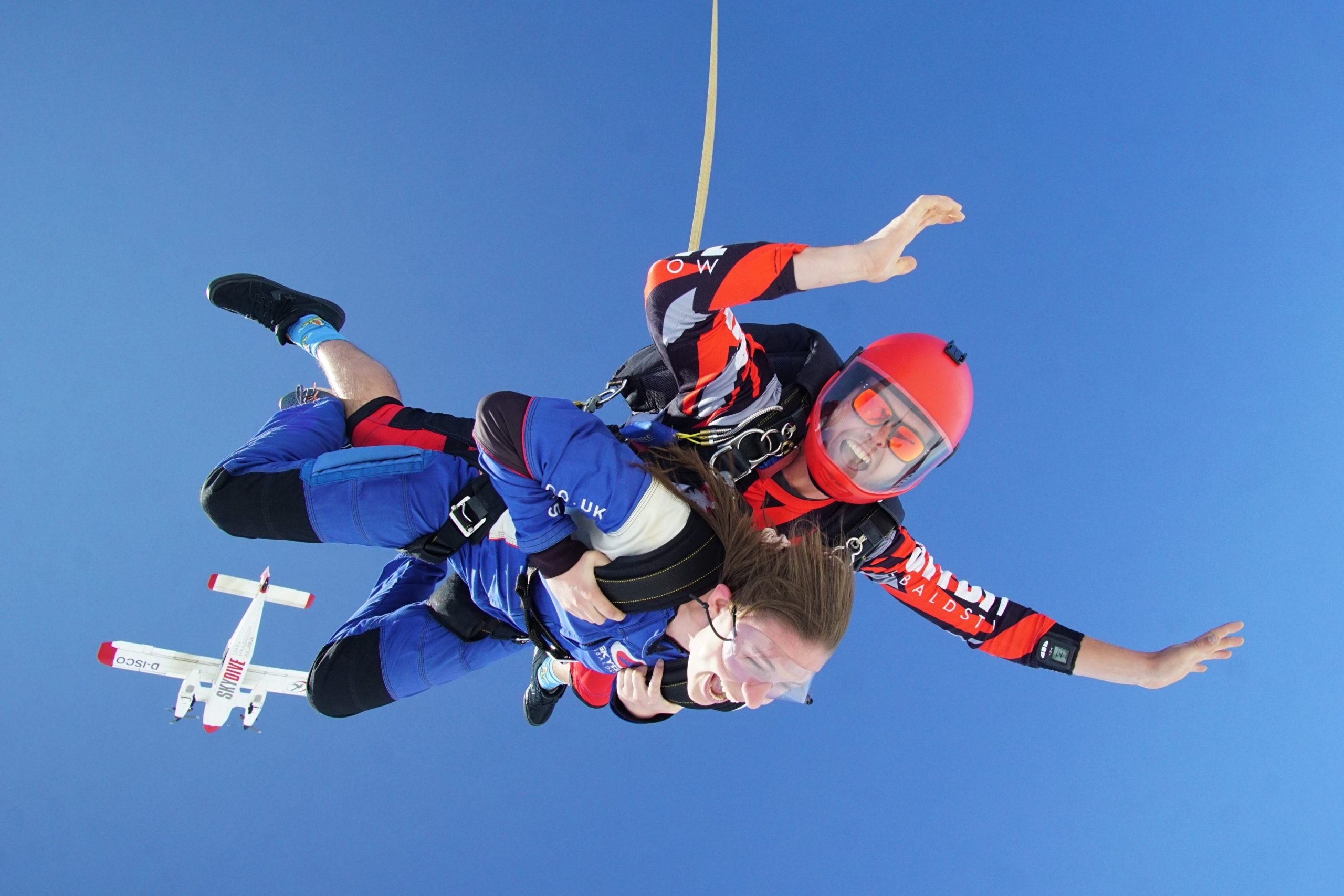
A tandem jump from 15,000 feet means approximately 60 seconds of freefall at around 120 miles per hour before the parachute deploys at 5,000 feet. You are harnessed directly to a qualified instructor throughout — they manage the exit, the deployment, and the landing. Your role is to arch your back, keep your head up, and try to register what is happening around you, which is harder than it sounds when the wind noise is drowning out everything else.
The canopy phase lasts five to seven minutes and is consistently reported as the most unexpectedly peaceful part of the experience. The noise of freefall stops almost instantly when the parachute opens. The view across the countryside — or coastline, or city, depending on the drop zone — becomes the only thing in front of you. Most people describe this phase as the part they think about longest afterwards, more than the freefall itself.
Tandem skydiving in the UK operates predominantly between April and October, with weather causing regular cancellations. Cloud cover, wind above 15 knots, and poor visibility all ground operations. Building flexibility into your booking date is not pessimism — it is just realistic about British weather and a sport that happens entirely outside.
The AFF Skydiving Course
The Accelerated Freefall programme is the internationally recognised training system for solo skydiving, governed in the UK by British Skydiving. It takes a complete beginner to licensed skydiver across eight jump levels, beginning with a full day of ground training covering equipment, emergency procedures, body position in freefall, altitude awareness, and canopy control.
The structure is logical. Level 1 involves jumping from 12,000 to 15,000 feet with two instructors holding on throughout freefall, communicating via hand signals, filming every second. Each jump is debriefed using the footage before the next level is briefed. By Level 3, one instructor steps back. By Level 8, the student exits and freefalls independently. After completing all eight levels, ten consolidation jumps are required before British Skydiving awards the A Licence — the qualification that allows unsupervised jumping at any affiliated drop zone in the world.
Currency rules matter and catch people out: if more than one month passes between jump levels, that level must be repeated. Inconsistent attendance adds both time and cost. The full course through minimum jumps runs to approximately £2,000 in the UK. Many students complete the course faster and more cheaply by travelling to Spain or Portugal, where reliable weather eliminates the waiting that inflates the UK timeline.
What Comes After
The A Licence is not an endpoint — it is a starting point. Formation skydiving, freeflying, canopy piloting, and eventually wingsuit flying all become accessible with experience. Wingsuit progression requires a minimum of 200 solo jumps before most drop zones will sanction training. The B Licence sits at 50 jumps. The C Licence at 200. The D Licence — the highest level in British Skydiving — requires 1,000 jumps and three accumulated hours of freefall time.
Indoor wind tunnels offer a useful parallel pathway. Twenty minutes of tunnel time in a vertical wind tunnel replicates the body position demands of several AFF levels, without weather dependency. Most serious AFF students use tunnel sessions between jump days to build freefall awareness faster than the weather in Britain typically allows.
adventuro lists skydiving adventures and AFF skydiving courses across the UK at adventuro.com — a practical starting point for comparing drop zones and operators before committing to a booking.
The people who ask about going again before they’ve even taken the harness off are the ones who end up doing the course. The tandem jump is designed to be a one-off experience. It just doesn’t always work out that way.